Learn about Glacier National Park climbing, photography, history, gear, safety and outdoor skills with practical advice from experienced local guides.
My Top Five Places To Photograph
My top 5 places to shoot in no particular order so they will be alphabetical.
Bowman and Kintla Lakes in the fall - dynamic shoreline with all of those lovely colorful rocks AND western larch. Go in early October and just enjoy the scene.
Going-to-the-Sun Road for nightscape photography - start at Wild Goose Island Overlook and follow the Milky Way all the way to Logan Pass. There are lots of places to stop but not all of them have open views. Do some planning and then go have some fun getting startled by all of the spooky noises that you will hear.
Lake McDonald - anywhere along the shoreline that is within 2 miles of Lake McDonald Lodge ... the mountains are close enough there to help you grab a huge scene ... make sure to use a polarized filter to get those rocks below the water surface.
Many Glacier - sunrise at Swiftcurrent Lake - get there at least an hour before sunrise. Take some extra layers because that wind can be vicious and hold on to your tripod!
Two Medicine Lake - most people like to photograph near the boat launch. I have other ideas and you should too. Explore a bit and you will find some beauty. Morning or evening … your call.
Where are your favorite places to shoot?
Meet the Team: Experience and Passion for Climbing in Glacier National Park
The Climb Glacier National Park guidebook series was built one summit at a time.
It took nine climbing seasons, hundreds of miles of hiking and scrambling, countless hours of route research and more than 60 people willing to join us on adventures into Glacier's high country.
Behind the guidebooks is a team of climbers who share a passion for Glacier National Park and exploring the places beyond the maintained trails.
Here are some of the people who helped make the Climb Glacier National Park series possible.
Lead Writer — Blake Passmore
Blake Passmore is the lead writer of the Climb Glacier National Park guidebook series.
A northwestern Montana native, Blake fell in love with the outdoors as a kid while hiking and exploring the valleys and mountains of the region. After spending time living in eastern Montana, he eventually moved back home and discovered a new passion: peak bagging in Glacier National Park.
His first Glacier summit was Pollock Mountain.
That first climb eventually led to years of exploring Glacier's mountains, photographing routes and helping create a five-volume guidebook series featuring 99 individual summits.
Blake's writing has also been recognized by the local community, where he was voted Best Author of the Flathead for four consecutive years.
For Blake, researching the guidebooks was never simply about collecting information. He had a blast traveling throughout Glacier, photographing routes, exploring new areas and standing on summits throughout the park.
Blake lives and works in northwestern Montana. He has three adult children, two great kid-in-laws and five spectacular granddaughters.
At age 56, he completed his first ultramarathon—a 33-mile race. When he isn't climbing, Blake enjoys photography, writing, fly fishing and plenty of other outdoor pursuits. Spring and fall often find him chasing big trout in Montana and Canada.
Does he want to climb every mountain in Glacier? Nope!
But there are still plenty of summits on the bucket list.
During the off-season, Blake stays busy photographing, writing, training for races and climbing—and somehow finding time for his other full-time job.
One of his favorite parts of writing the Climb Glacier guides is hearing from readers who use them to reach their first Glacier National Park summit.
If that's you, drop Blake a note through our Contact Us page. We'd love to hear about your adventure.
Contributing Authors — “The Doctors”
Dr. John VanArendonk
Dr. John VanArendonk is a native Montanan who returned to the Flathead Valley after completing his training as a physician.
John developed his passion for climbing while attending youth camps in the Rocky Mountains and has spent years exploring Glacier's backcountry.
He is the former medical director of the ALERT helicopter program at Kalispell Regional Medical Center and also enjoys hunting, fishing and camping.
More importantly to this project, John was there near the beginning. When Blake first proposed creating a climbing guidebook using photographs with routes drawn directly onto the mountains, John encouraged him to pursue the idea and agreed to help research the routes.
That conversation helped launch what eventually became the Climb Glacier National Park guidebook series.
Dr. Scott Burry
Dr. Scott Burry was born in Indiana, but his heart has been in the mountains since childhood.
After completing medical school and his residency training, Scott settled near Spearfish, South Dakota.
One of Scott's particular interests is Wilderness Medicine. He has also traveled to Peru multiple times as a team leader on medical missions along the Ucayali River.
His medical experience, outdoor background and love of the mountains made him a valuable member of our climbing team.
Dr. Brad Roy
Dr. Brad Roy is an exercise physiologist and accomplished runner.
He achieved a personal-best marathon time of 2:21 in 1982 and continues to enjoy day hikes and backpacking trips into remote places.
Brad holds a Ph.D. in clinical exercise physiology and is a Fellow of the American College of Sports Medicine.
His combination of endurance experience, exercise science and love of the backcountry brought another valuable perspective to our team.
Other Contributors to Volume 5
Chris Rost
Chris Rost brought additional climbing and mountaineering experience to our team.
His adventures have included summiting Granite Peak, Montana's highest mountain, on his third attempt, as well as climbing trips to Mount Rainier and Red Rocks near Las Vegas. He also enjoys ice climbing and photography.
Chris loves backcountry camping and exploring Glacier's high places. He climbed numerous peaks with us during the research for earlier volumes and became an important member of the Volume 5 writing team, researching and writing several of its routes.
Chris lives in Kalispell and is a Physician Assistant.
Mike VanArendonk
Mike VanArendonk was the youngest member of our writing team.
Like his father, John, Mike developed a love for Glacier National Park and its backcountry.
While pursuing his degree in physical therapy, Mike completed an internship with Fisio Med S.A. in Quito, Ecuador. During his time in Ecuador, he summited Cayambe, the country's third-highest peak, at approximately 18,996 feet.
Mike also played basketball and football locally before bringing his athleticism and enthusiasm to our climbing team.
For Volume 5, Mike researched, climbed and wrote the routes for Kupunkamint Mountain, White Calf Mountain and Amphitheater Mountain.
And More Than 60 Others...
Then there are all the people whose names aren't on the cover.
We haven't forgotten them.
It took nine climbing seasons to complete the Climb Glacier National Park series, and more than 60 people joined us in reaching the summits featured in these guidebooks.
Some climbed one mountain with us. Others came back again and again.
Every one of them contributed to this project by answering the call when we needed a climbing partner, helping research a route, sharing an adventure or simply spending a long day with us in the mountains.
Without them, this series literally could not have been completed.
To every person who joined us along the way:
Thank you for answering the call. Thank you for sharing the adventure. And thank you for helping us create Climb Glacier National Park.
GO EXPLORE GLACIER.
Difficulty Rating System: How Hard Will Your Glacier Adventure Be?
Not every climb feels the same—and difficulty isn't determined by mileage or elevation gain alone.
The Climb Glacier National Park Difficulty Rating System describes the physical exertion you can expect during an adventure. These ratings are based on the firsthand experiences and opinions of the authors and our climbing partners.
Your experience may be very different.
Fitness, training, previous climbing experience, weather, nutrition, hydration and even your mental attitude can dramatically affect how difficult a particular climb feels.
Some Days You've Got It. Some Days You Don't.
Every climber knows the feeling.
There are days when everything comes together. Your legs feel strong, you've eaten well, you're hydrated, the weather cooperates and the miles seem to pass easily.
Life is good!
Then there are the other days.
You're dragging your body up the trail. Your legs feel heavy. Your energy isn't there. Something simply doesn't feel right.
Pay attention to those signals.
A successful day in the mountains doesn't always end on the summit. Sometimes the best decision you can make is to recognize that today isn't your day, listen to your body—and your climbing partners—and turn around.
The mountain will still be there.
Painless — Well, Almost
These adventures are a great place for beginning climbers to start.
Typical one-way distance: Less than 3 miles (4.8 km)
Typical total elevation gain: Less than 1,500 feet (457 m)
If you're new to scrambling or off-trail travel in Glacier National Park, this is an excellent difficulty level for discovering whether you enjoy leaving the maintained trail behind.
These adventures still require some effort, but they're generally manageable with a little time, patience and basic physical conditioning.
Of course, there are always exceptions. Apgar Lookout is a good example.
Tolerable — Sort Of
Many of the adventures featured in the Climb Glacier guidebook series fall into this category.
Typical one-way distance: Less than 5 miles (8.0 km)
Typical total elevation gain: Less than 2,500 feet (762 m)
This is where physical conditioning becomes increasingly important.
A well-conditioned climber may find these routes enjoyable, while someone who hasn't prepared physically may find the exact same trip exhausting.
The best advice?
Get in shape before you arrive in Glacier.
You'll enjoy the climb—and the rest of your vacation—a lot more.
Challenging — Pretty Much
Welcome to Weekend Warrior territory.
Typical one-way distance: Less than 8 miles (12.9 km)
Typical total elevation gain: Less than 4,000 feet (1,219 m)
Many Glacier National Park summits require this level of physical exertion.
A Weekend Warrior may successfully complete one of these routes, but there's a good chance they'll know exactly what they did when they get out of bed the next morning!
Our recommendation: Don't train like a Weekend Warrior.
Start an exercise program before your trip and stick with it. Build your endurance, strengthen your legs and prepare your body for sustained uphill travel.
Your body will thank you.
Arduous — Absolutely
These are the big days.
Typical one-way distance: More than 8 miles (12.9 km)
Typical total elevation gain: Often well over 4,000 feet (1,219 m)
These routes are for the He-men and She-gals who somehow never seem to find quite enough challenge.
Long distances, major elevation gain and hours of sustained physical effort require excellent conditioning. You should be in top physical shape before attempting adventures at this level.
One option for making an arduous route more manageable is turning it into an overnight trip when regulations, route logistics and camping options allow.
Know Yourself Before You Go
Remember that our Difficulty Rating System measures physical exertion. It is different from a climbing classification that describes the technical difficulty of the terrain.
A route can be technically straightforward but physically exhausting—or short and physically manageable while containing more difficult scrambling.
Use both pieces of information when choosing your adventure.
Most importantly, be honest about your conditioning and experience. Eat, hydrate, prepare properly and pay attention to what your body is telling you.
The goal isn't simply to reach the summit.
The goal is to have a great adventure—and get back safely.
GO EXPLORE GLACIER.
Update For Volume 4 - Many Glacier Routes
The NPS has placed seasonal closures on two routes featured in Volume 4. Check for closures on routes to Altyn Peak and Mount Henkel.
Check in with the Many Glacier Ranger Station to get all of the details about status of current closures.
During that closure you can access these summits from the following peaks or locations. They have restricted access due to presence of grizzlies in that area and we have frequently seen them in that area.
Altyn Peak can to be accessed via the Natahki Lake Basin above Apikuni Falls on the Apikuni Mountain route.
Mount Henkel can be accessed from either Apikuni Mountain or from Crowfeet Mountain.
Course Corrections
We had a few “oops” moments when we were entering waypoints in Volumes 1 (first printing) and 2.
You can download the pdf for Course Corrections by clicking the link below.
VOLUME ONE COURSE CORRECTIONS
VOLUME TWO COURSE CORRECTIONS
Rating Your Adventure: Understanding Glacier National Park Climbing Ratings
Not all summit routes in Glacier National Park are created equal.
Some involve relatively easy off-trail walking. Others require scrambling, route-finding, exposure and technical climbing skills. Understanding the rating system before you leave the trail is an important part of choosing an adventure that matches your ability and experience.
A Rating System Designed for Glacier
Dr. J. Gordon Edwards, author of the classic A Climber’s Guide to Glacier National Park, developed a climbing classification system specifically for Glacier. The Glacier Mountaineering Society (GMS) expanded the system to include overall route difficulty, the difficulty of the hardest section, round-trip distance and elevation gain.
There is one important thing to remember:
Glacier National Park climbing classifications are specific to Glacier. A Class 3 route in Glacier should not automatically be considered equivalent to a Class 3 route somewhere else.
The Glacier Mountaineering Society system gives you several pieces of information in one compact rating.
For example:
Class III (3) MS
This tells us the overall difficulty, the difficulty of the hardest section, the distance and the elevation gain.
Let's break it down.
Glacier Climbing Classes
Class I (1) — Easy
Trail hiking or off-trail walking that does not require the use of your hands.
Examples from our guidebooks include:
Cataract Mountain — Volume 1
Haystack Butte — Volume 1
Portions of Mount Oberlin — Volume 1
Class II (2) — Moderate
Low-angle scrambling where you may begin using your hands for balance or movement.
Examples include:
Mount Helen — Volume 2
Piegan Mountain routes — Volume 1
Cliff section on Mount Oberlin — Volume 1
Class III (3) — Difficult
High-angle scrambling, moderate cliffs and considerably more exertion. Exposure may become an important factor, and a rope may be appropriate for less-experienced climbers.
Examples include:
Reynolds Mountain — Volume 1
The Dragon’s Tail — Volume 1
Edwards Mountain — Volume 3
Class IV (4) — Very Difficult
Higher-angle cliffs with increased exposure. The GMS classification describes this terrain as requiring a rope for belaying.
Examples include:
The Great Cleft on Pollock Mountain — Volume 1
Portions of Sinopah Mountain — Volume 2
Portions of Painted Tepee Peak — Volume 2
Class V (5) — Severe
High-angle cliffs with severe exposure. Technical climbing experience is necessary, and protection is placed by the lead climber.
Climb Glacier National Park does not include any routes with an overall Class V rating.
Class VI (6) — Extremely Severe
This classification involves direct-aid technical climbing and is reserved for major technical climbs such as the North Face of Mount Siyeh or East Face of Mount Gould.
Climb Glacier National Park does not include any routes with an overall Class VI rating.
Understanding the Number in Parentheses
This is one of the most useful parts of the GMS system.
The Roman numeral describes the overall difficulty of the route, while the number in parentheses identifies the most difficult section of the climb.
For example:
Class II (3)
Most of the route is Class II, but the climber should expect at least one section of Class 3 terrain.
That distinction can make a big difference when deciding whether a particular summit is appropriate for you.
Distance and Elevation Ratings
GMS also rates the physical demands of the trip using S, M and L.
Rating
Round-Trip Distance - Elevation Gain
S — Short = 1–6 miles - Less than 3,000 feet
M — Medium = 6–12 miles - 3,000–4,500 feet
L — Long = 12–20+ miles - More than 4,500 feet
The first letter represents distance and the second represents elevation gain.
Putting It All Together
Consider this example:
Class II (3) MS
The route is primarily Class II with a Class 3 section at its most difficult point. It covers 8 miles (12.8 km) round trip—Medium distance—with 2,800 feet (853 m) of elevation gain—Short elevation.
Now consider:
Class IV (4) LL
This is an overall Class IV climb with Class 4 terrain at its most difficult point. The trip covers 14 miles (22.5 km) and gains 5,000 feet (1,524 m)—Long in both distance and elevation.
With a little practice, those few letters and numbers tell you a tremendous amount about the adventure ahead.
Choose the Right Adventure
One of the great things about climbing in Glacier is the variety. You don't have to tackle the most difficult summit to have an incredible day.
Start with routes that match your experience. Learn how Glacier's terrain and rock feel. Develop your scrambling and route-finding skills gradually. Then move into more difficult terrain as your experience and confidence grow.
The rating system is a valuable starting point—but remember that weather, snow, route conditions, exposure and your own abilities can dramatically change the difficulty of any climb.
Know the rating. Know your abilities. Choose your adventure.
GO EXPLORE GLACIER.
The GMS Rating System is used in the Climb Glacier National Park guidebooks with permission from the Glacier Mountaineering Society.
This Is Our Story: How Getting Off-Route Led to Climb Glacier National Park
Climb Glacier National Park exists because we got off-route.
It really is that simple.
After several years of climbing peaks in Glacier National Park and relying on the written route descriptions available at the time, we began to see a need for something different—a guidebook that didn't just tell climbers where to go, but actually showed them.
It Started on Clements Mountain
The idea began in 2003 on Clements Mountain near Logan Pass.
During the climb, two members of our group got off-route and found themselves in unnecessary Class IV terrain. The climbing was more difficult—and potentially more dangerous—than it needed to be.
Fortunately, we eventually located the goat trail on the Bird Woman Valley side of Clements Mountain and found our way back onto the route.
Afterward, we started talking about what had happened. We realized that a photograph of the mountain with the safest route drawn directly onto the image would have made finding our way much easier.
So that's exactly what we started doing.
We took photographs of Glacier's mountains and drew red lines showing the climbing routes. For the next few years, we shared those photographs with friends. They worked.
That simple idea would eventually become the foundation of the Climb Glacier National Park guidebook series.
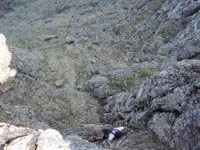
We got lucky this day.
From an Idea to the “Passmore Guides”
A few years later, while hiking the Huckleberry Lookout Trail, Blake Passmore shared the idea of creating an actual climbing guidebook using the red-line photographs with his friend John VanArendonk.
John's response was simple: Go for it.
Even better, he agreed to help research routes and contribute to the project.
The Huckleberry Mountain Trail had been named one of America's ten most dangerous hikes by Backpacker magazine because of its grizzly bear activity—which seemed like a fitting place to start talking seriously about a Glacier adventure guidebook. Backpacker
What followed was ten years of climbing, research, photography and repeated trips into Glacier's backcountry.
By the time we finished, the Climb Glacier National Park series included illustrated climbing routes to 99 individual summits.
Every peak featured in our books has been climbed by the authors. That firsthand experience allows us to describe the routes, challenges and options based on actually being there.
Go Explore Glacier
One of the things we love most about Glacier National Park is what exists beyond the maintained trails.
Many visitors assume that all off-trail travel in Glacier is prohibited. It isn't. However, the park does maintain specific areas where off-trail travel is prohibited, along with temporary, wildlife-related and seasonal restrictions. Those closures can change, so climbers should always check current National Park Service information before heading out. NPS regulations and off-trail closures
For those prepared to leave the trail behind, Glacier offers an incredible range of opportunities—from relatively straightforward off-trail adventures to challenging summit routes.
That's what Climb Glacier National Park is all about.
Our guidebooks combine written route descriptions with photographs showing the routes directly on the mountain, helping climbers understand where they're going before they get there.
What began with getting off-route on Clements Mountain has grown into what many climbers now simply call the “Passmore Guides.”
They were created for one reason: to help you explore more of Glacier National Park and do it with better information.
Choose your route. Plan your climb. Go explore Glacier.
Important: Access and wildlife closures can change. Mount Henkel and Altyn Peak, in particular, may be affected by wildlife closures associated with grizzly bear activity. Always check Glacier National Park's current conditions and closures before beginning a climb.
Explore the complete GUIDEBOOK SERIES on this page.